What we do
Three ways we build with you
Every engagement starts with the system you already have. We add capability to it rather than asking you to replace it.
Build
Intelligent systems
Custom platforms built to scale, to integrate, and to reason. When a system holds millions of rows and still has to answer a specific question for a specific person, that is an AI problem sitting on top of a solid engineering one, and we build both halves. The agentic layer is already ours — our own framework rather than a vendor’s — so you get a platform an agent can operate as part of the build, instead of paying for it as a project of its own.
What that includes
- Platform architecture and technical discovery
- Custom application and API development — role-permissioned and agent-callable by default
- Fully agentic systems that take action on a platform, not just answer questions about it
- RAG and deep search over large, private datasets
- Agent access included, on our own framework rather than a vendor’s
- Secure handling of sensitive records and personal data, and the compliance each market you operate in demands
- Integration across existing enterprise tooling — inventory, fulfillment, CRM
- Taking over a stack you already run, including systems we did not build
- Cloud infrastructure, CI/CD, monitoring and observability
- Hosting and managed operations — we run it, not only build it

Scale
Automated content
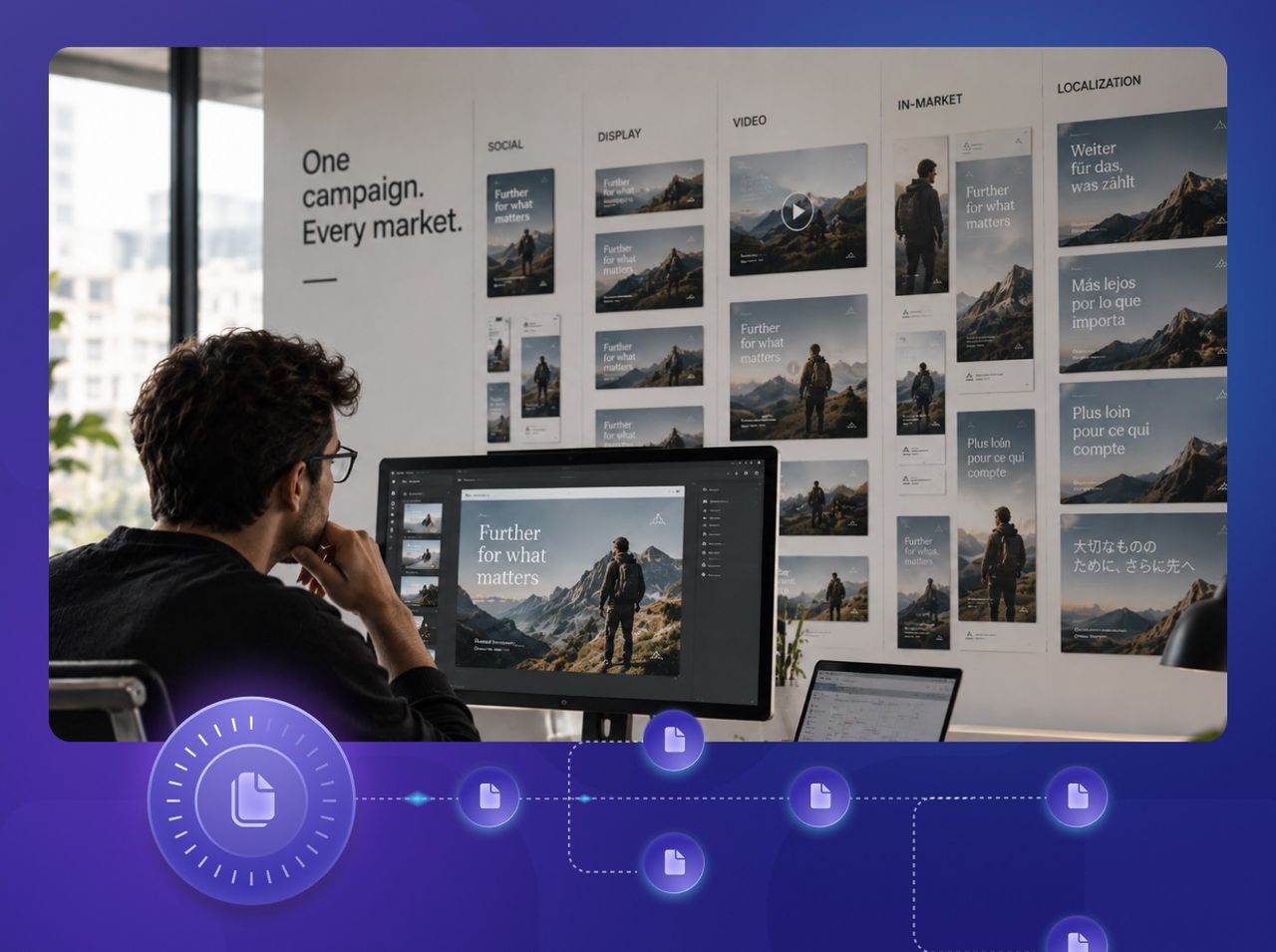
Content that multiplies faster than any team can make it. The moment your output is a product — markets × languages × formats, or people × assets — the count runs away from you: two thousand people with two dozen assets each is forty-eight thousand finished pieces, and whatever you just estimated is low, because everyone forgets a variable. So most of it never gets made, and the material that should have carried someone’s name doesn’t exist. We build the pipeline that produces all of it, on brand. An LLM will draft any one piece now; what it will not do is hold structure, brand and correctness across every piece — so we pair the two and let each do what it is good at.
What that includes
- Programmatic creative generation at campaign volume
- Personalized output at headcount scale — one profile driving the cards, print, flyers and video that carry that name
- Multi-page documents assembled to order, with sections that vary by data or by selection
- LLM generation paired with a system that enforces structure, brand and correctness — conformance built in, not caught in review
- Translation and localization across languages and markets — adapted for each market, not only translated for it
- Captioning, translation and AI dubbing for video, on AI stacks we run ourselves
- AI interpretation
- Approval, governance and brand-compliance workflows
- Integration with existing DAM and CMS platforms
Engage
Connected experiences
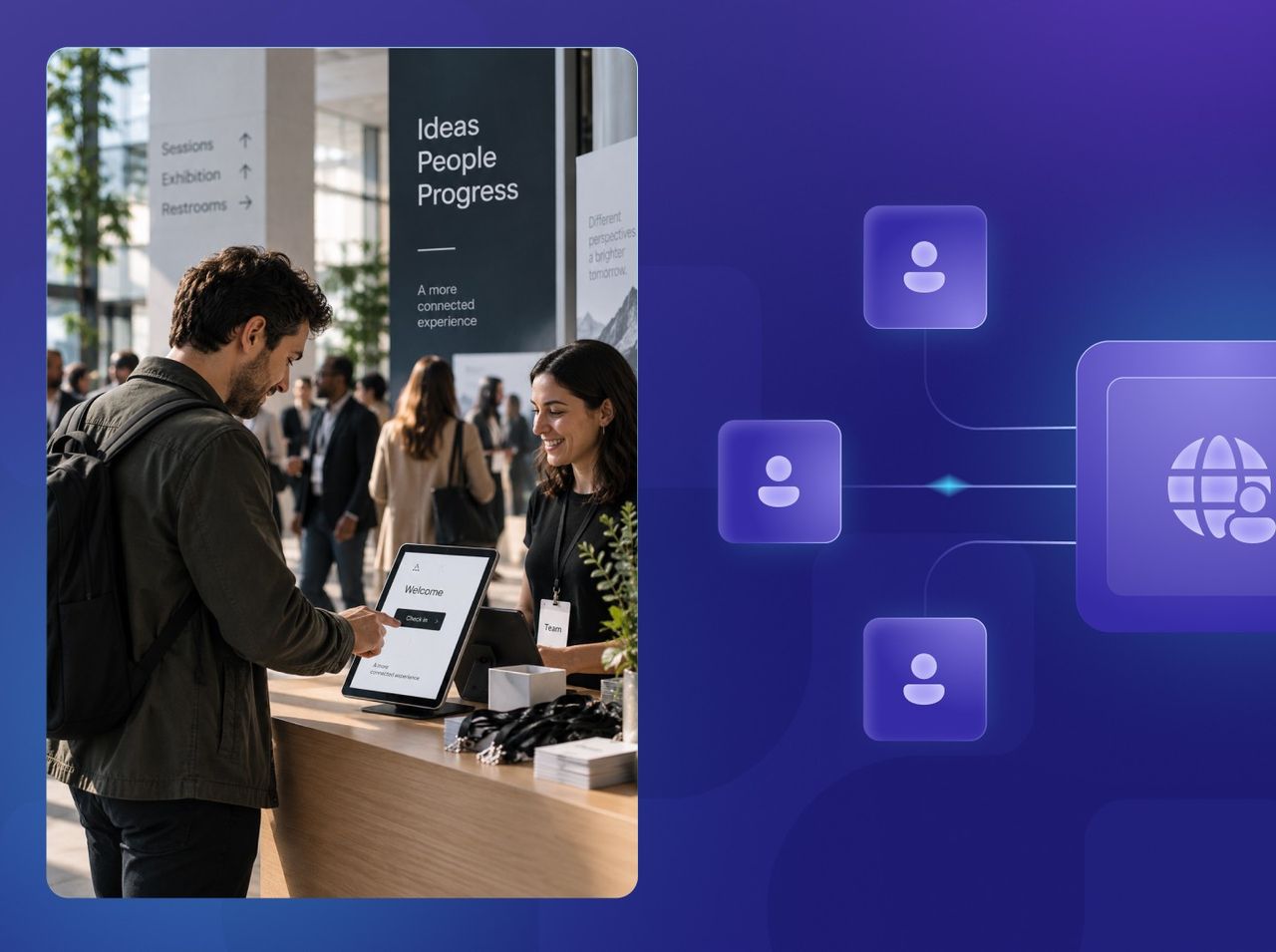
User-first design that bridges technology and engagement. The interface is where the system meets the person using it, and we treat that as an engineering problem as much as a design one — whether that person is a partner working through a skilling path, a shelter signing up in five minutes, or fourteen thousand people arriving at a venue. We run accessibility reviews as a service, and it shapes everything else: our language and translation capability grew out of the push for accessibility long before it was about reaching new markets.
What that includes
- Skilling and learning platforms, including custom LMS experiences
- Event operations — registration, QR check-in, surveys and badge printing
- Public voting and contest platforms, with fraud detection built in
- Experience strategy, interface design and design systems
- Accessibility review and remediation against WCAG, with tooling that surfaces issues a manual pass misses
- Analytics, measurement and iteration
The other half of the build
The platform your team lives in
Every system we ship has two faces: the one the public sees, and the administration platform behind it — the one your team opens every morning. You get that built as a first-class product rather than a settings screen bolted on at the end, because it is the half that decides whether the system is still useful in three years. It is normally the half that makes a project run long. Ours start on engineering we already own, so the time goes into what is specific to you instead.
Deep enough to actually run on
Your team should never have to leave the platform, open a spreadsheet, or ask us to run a query for them. Getting there takes hundreds of endpoints — roughly 800 on one of the platforms we operate — and it is the difference between software a team runs the business on and software they work around.
Find one record among millions
Your operators get search that still returns in a blink when the table holds millions of rows — the single thing that decides whether an admin platform stays usable as the data grows. We index for it from the start rather than discovering it later.
Run the operation, not just the settings
The platform is where the work happens, not where it is configured. One we run handles live events end to end — registration, QR check-in, surveys and on-site badge printing — next to a catalog of hundreds of sessions in ten languages.
Content, taxonomy and structure
Courses, badges and learning paths sit on top of a managed taxonomy: programs, partners, providers and collections, each with its own editorial surface. Structure at this scale is a feature, not an implementation detail.
Marketing and communications built in
Email campaigns with reusable layouts and block templates, delivery analytics, announcements, cross-promotions, an event calendar, surveys and forms — the operator never leaves the platform to run a program end to end.
Analytics as a first-class surface
Not an exports tab. Live dashboards covering engagement, completion and redirect paths, broken down by country, language, company, region and job role, with a geographic view and daily-through-yearly trends.
Works where your operation actually is
Admin tooling does not have to stop at the office. We put it on the warehouse floor — kit definitions, live inventory, recipient records, and a label scan that catches a mispacked kit before it ships.
Under the surface
Every endpoint is a product surface
The APIs behind our platforms are not private plumbing that happens to be reachable. Each one is built to be permissioned, delegated to your own developers, and called by an agent on a user’s behalf — which is why adding AI to one of our systems is a configuration question rather than a rebuild.
Role-based permissions, per endpoint
Permissions are part of an API’s own definition rather than a gateway bolted in front of it. Almost every endpoint on these platforms carries its own role rules, so what a person can do is answered in one place.
Scoped tokens for your developers
Any endpoint can be exposed as a token-scoped capability. Your own engineers build against exactly the surface the product uses — no shadow API, no second-class integration path, no waiting on us.
AI-enabled search
Real AI-enabled search, plus retrieval-augmented generation (RAG), helps users and AI agents unlock data that keywords alone cannot reach.
Agentic infrastructure
Our highly expressive agentic framework allows an LLM to make calls on the user’s behalf, while unlocking new modalities and methodologies.
How we work
No two engagements look the same
What stays constant is where we start and what we start from.
Bespoke, not templated
We do not run every engagement through the same four-phase methodology, because the problems clients bring us do not share a shape. What a kitting platform needs and what a global skilling program needs have almost nothing in common. We can build most things; we are at our best when the thing has not been built before.
We start from what you already run
The first question is what exists — the systems, the constraints, the things that cannot change. We add capability to that rather than asking you to replace it, which is usually the difference between a project that ships and a migration that stalls.
Rarely a standing start
Almost everything we build runs on engineering we already own and maintain. Auth, translation, email, logging, deployment and the agentic layer are solved before your project starts — so you get to market faster and pay less to get there, because the budget goes to the part that is actually yours.
We run on this ourselves
Our own operations are AI-first, not AI-curious. Our agents work against a task platform we built, our translation and interpretation stacks are ours to run, and the design side has the same modern tooling as the engineering side. It is how we know what works before we put it anywhere near your project.
Brands we have built for